
By Daniel Oloro
Political Analysis | August 4, 2026
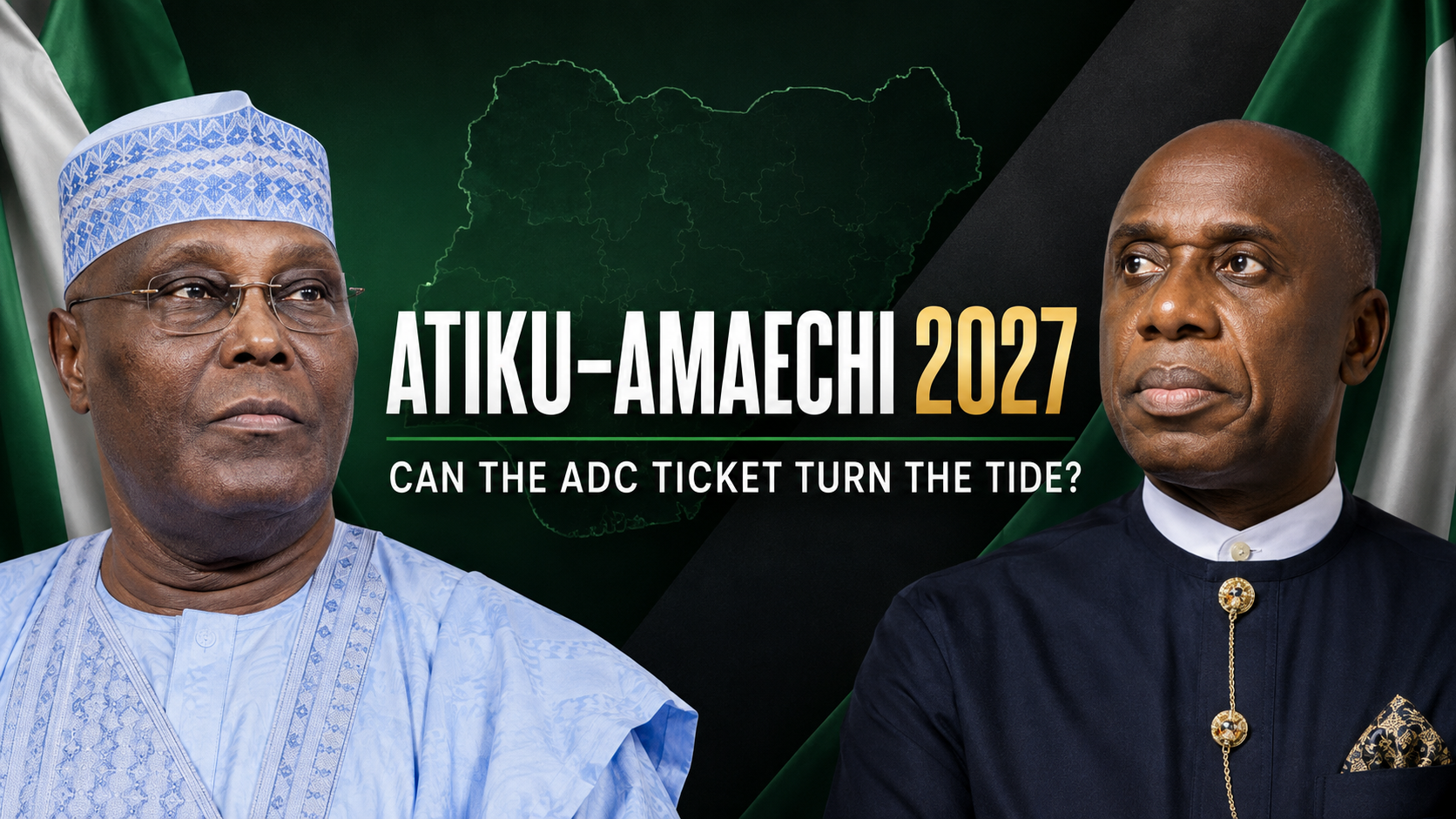
Atiku Abubakar’s emergence as the African Democratic Congress presidential candidate, with former Rivers State governor Rotimi Amaechi as his running mate, has given Nigeria’s 2027 presidential contest a clearer shape. The combination brings together two experienced politicians with national campaign networks, but experience alone will not make the ADC ticket the favourite.
The central political question is whether Atiku and Amaechi can convert widespread frustration over living costs, insecurity and government performance into one sufficiently broad opposition vote. For now, the answer remains uncertain.
Atiku is a serious challenger. Amaechi improves the balance and organisational credibility of the ticket. Yet President Bola Tinubu retains the advantages of incumbency, control of the federal government, a large party structure and support from numerous governors. The continued division of opposition votes, especially following the departure of Peter Obi and Rabiu Kwankwaso from the ADC-led alliance, may remain Tinubu’s strongest electoral protection.
What Atiku brings to the 2027 contest
Atiku enters the race with national recognition, extensive political relationships, campaign financing capacity and a tested northern base. He served as Nigeria’s vice president from 1999 to 2007 and has spent decades building relationships across the country’s six geopolitical zones.
His 2023 performance also shows that he cannot be dismissed. Atiku received approximately 6.98 million votes, about 29 percent of the valid votes cast, while Tinubu won with approximately 8.79 million votes. That result demonstrated both Atiku’s national reach and his central difficulty: he needs to expand beyond his established coalition while opposition votes remain divided.
Atiku’s experience may reassure voters looking for economic competence and stability. However, it also creates liabilities. By the 2027 election, he will be 80 years old. Many Nigerians associate him with the longstanding political establishment, repeated presidential contests and frequent party realignments. Younger voters may recognise his name without feeling personally invested in his candidacy.
His task is therefore not to become more famous. It is to become more believable as the answer to Nigeria’s present problems.
What the Amaechi factor changes
Amaechi gives the ticket regional and religious balance. A northern Muslim presidential candidate paired with a southern Christian running mate creates a contrast with the APC’s Muslim-Muslim ticket. It may help the ADC appeal to Christian voters who remain uneasy about the ruling party’s national ticket.
Amaechi also brings experience as a two-term Rivers State governor, former transportation minister and senior figure in Muhammadu Buhari’s successful presidential campaigns. He understands campaign logistics, political negotiation and the importance of building an election-day structure.
But Amaechi’s influence should not be exaggerated. He does not automatically deliver Rivers State or the wider South-South. Nyesom Wike retains a powerful political network in Rivers, and other South-South states have their own governors, party organisations and local interests. Amaechi can make Rivers more competitive; he cannot simply transfer the state to Atiku.
More importantly, Amaechi cannot replace Peter Obi’s appeal among many younger, urban and South-East voters. He strengthens Atiku’s establishment coalition, but he does not automatically solve the ticket’s emotional and generational connection problem.
Current public sentiment: anti-incumbent, but not automatically pro-Atiku
The public mood presents Atiku with a genuine opportunity. Many households continue to feel pressure from food prices, transport costs, energy expenses, unemployment and insecurity. The federal government’s economic reforms have received support from some investors and international institutions, but their benefits have not been experienced evenly.
Reuters reported in July that savings associated with subsidy removal had been substantially absorbed by debt-servicing costs and higher government spending. Although economic growth and inflation indicators have shown areas of improvement, headline economic gains do not necessarily mean that families feel financially secure.
This produces strong anti-incumbent sentiment, but dissatisfaction with Tinubu should not be confused with enthusiasm for Atiku. Some voters may choose Obi, another opposition candidate or abstention. Others may criticise the government but still prefer the continuity, state machinery or regional calculations offered by the APC.
Sentiment toward Atiku is best described as mixed. Supporters view him as experienced, business-friendly and capable of managing the economy. Critics see a perennial candidate who represents the same political class Nigerians increasingly distrust.
Amaechi creates additional energy around the ticket, particularly among voters who oppose Wike or respect his role in the 2015 opposition victory. However, questions remain about his current grassroots strength, his record in federal office and whether the ticket represents genuine renewal or another recycling of established figures.
The regional path remains difficult
Atiku’s strongest natural base remains the North-East. He is also capable of competing across the North-West and North-Central, where insecurity and economic hardship could weaken the incumbent. However, APC governors and local political structures will make both zones difficult.
In the South-South, Amaechi gives the ADC a stronger entry point, but every state requires separate negotiation. Rivers will be a direct test of Amaechi’s remaining influence against Wike’s organisation.
The South-East is a larger strategic problem. If Obi remains in the race, Atiku may struggle to build the overwhelming support he needs in the zone. In the South-West, Tinubu retains a structural advantage, even if economic dissatisfaction reduces his winning margins.
The election is therefore likely to be decided less by national online sentiment than by a combination of northern margins, opposition fragmentation, turnout and the ability of each party to protect votes at polling-unit level.
What Atiku can do now to turn the table around
Atiku’s disadvantage is not irreversible. The present political climate gives the opposition an opening, but the ADC cannot wait for hardship alone to defeat the incumbent. It must convert anger into trust, organisation and turnout.
1. Reposition Atiku as a measurable solution
The campaign should move beyond daily criticism of Tinubu. Nigerians already understand the difficulties they face. Atiku must explain, in clear and repeatable language, what he would do differently on food costs, jobs, electricity, security and small-business survival.
A small number of measurable commitments would be more persuasive than another lengthy manifesto that few voters read. Every major interview and campaign appearance should reinforce the same household-focused programme.
2. Present him as a transitional reform president
Atiku cannot credibly campaign as a fresh political outsider. A more believable positioning would present him as an experienced transitional president whose purpose is to stabilise the economy, rebuild institutions, reform the federation and prepare a younger generation of leaders.
That message must be demonstrated by placing credible younger Nigerians, women, professionals, entrepreneurs and civil-society figures at the visible centre of the campaign, with real responsibility rather than ceremonial roles.
3. Build one Atiku-Amaechi governing partnership
The ticket should not operate as two separate regional campaigns. Nigerians need to see a functional partnership with clearly defined priorities. Atiku can lead the economic recovery and restructuring message, while Amaechi reinforces infrastructure, public-sector reform and national integration.
Their joint appearances should communicate trust, competence and a shared governing philosophy. Any public rivalry would quickly weaken the ticket.
4. Reopen opposition negotiations without public hostility
A public war with Obi, Kwankwaso or their supporters would be strategically damaging. It would deepen emotional resistance and make later cooperation more difficult.
Trusted intermediaries should pursue private negotiations that could produce endorsements, regional understandings, coordinated election protection or another arrangement that prevents opposition votes from cancelling one another. Full party unification is not the only form of useful cooperation.
5. Replace rallies with a national listening campaign
Before asking for votes, Atiku and Amaechi should hold structured engagements with market associations, farmers, transport workers, manufacturers, young professionals, displaced communities and small-business owners.
Each engagement should produce a visible policy response. This would make Atiku appear less like a perennial candidate returning for another election and more like a prospective president preparing to govern.
6. Build a professional rapid-response media operation
The campaign needs a disciplined communications centre responsible for daily message coordination, fact-checking, spokesperson preparation, media monitoring, crisis response, local-language content and short-form video.
Its purpose should not be to flood the internet with propaganda. It should answer attacks quickly, correct false information with evidence and keep every recognised campaign voice aligned with the ticket’s central promises.
7. Treat the election as a polling-unit contest
Social-media trends and large rallies do not protect votes. The ADC must recruit and train polling agents, establish legal-response teams, build secure result-reporting procedures and identify the exact wards where turnout or margin reduction will determine the national outcome.
A presidential campaign without a reliable polling-unit organisation is a publicity exercise, not a winning electoral structure.
8. Address the trust problem directly
Atiku will face questions about age, corruption allegations, party switching and his repeated pursuit of the presidency. Ignoring them will allow opponents to define him.
He should answer difficult questions directly and publish specific safeguards covering procurement, appointments, asset disclosure, government spending and performance measurement. The argument should not be that any politician is beyond criticism; it should be that an Atiku administration would be constrained by transparent systems.
Final assessment
The Atiku-Amaechi ticket is competitive, but it is not yet the favourite. Amaechi improves regional balance, campaign experience and the ADC’s ability to contest parts of the South-South. He does not automatically deliver Rivers, unite the opposition or transfer Obi’s supporters to Atiku.
Tinubu’s greatest vulnerability is the lived economic experience of millions of Nigerians. His greatest advantage is that the opposition may once again divide the votes of citizens who want change.
Atiku can turn the table only if he becomes more relevant to present-day voters, reaches workable agreements with competing opposition leaders, offers a credible household economic programme and builds a disciplined organisation capable of operating in every ward.
This public assessment outlines the broad strategic direction available to the Atiku-Amaechi campaign. A complete path-to-victory framework would require confidential voter research, state-by-state electoral modelling, opposition mapping, message architecture, media monitoring, crisis-response planning and a detailed implementation timetable.
This article is an independent political analysis by the author. The assessments and strategic recommendations expressed do not constitute an endorsement by DiasporaTV.
About the author: Daniel Oloro is a media and political communications analyst whose work focuses on public sentiment, strategic messaging, political positioning and electoral communications.
Sources: Independent National Electoral Commission, 2023 election results; Reuters on the opposition split; Reuters on subsidy savings and public finances; The Guardian on the Atiku-Amaechi ticket; BusinessDay on the Rivers political contest.